
The Furka, before the loop fills
Switzerland's classic alpine crossing, the Rhône Glacier, and why an early start still rewards the driver.
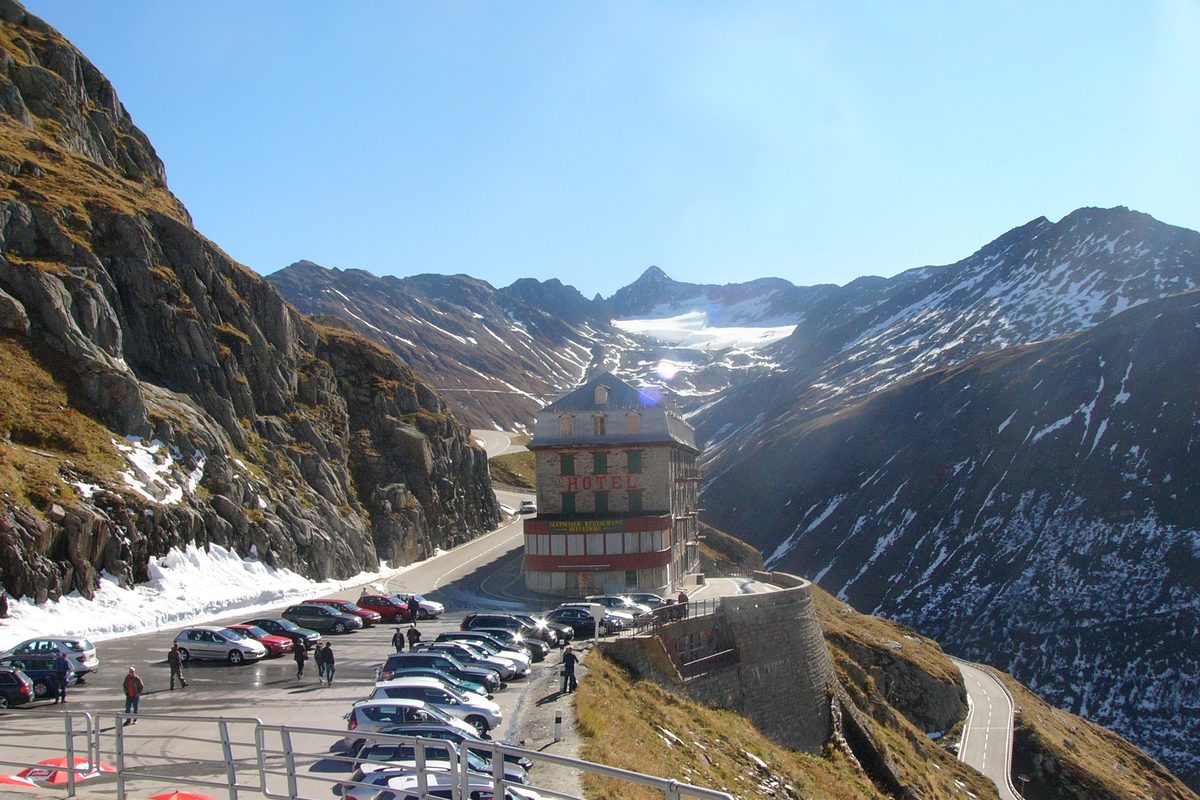
Some alpine roads exist to get you from one valley to another. The Furka Pass exists to make you stop. At 2,429 metres it links Realp in Uri with Gletsch in Valais on Road 19, a seasonal crossing of about twenty-nine kilometres with gradients that reach eleven per cent. From the west side the road drops in hairpins past the stone bulk of the Hotel Belvédère, and from the east it climbs out of the Urseren Valley into thin air and long views. Paired with the neighbouring Grimsel and Susten, it forms the classic Three Passes loop that Swiss drivers have treated as a day out for generations.
A road with a long memory
The pass was used long before it had a modern surface. Goethe crossed it in deep snow on 12 November 1779. The carriage road itself was built between 1863 and 1866, with federal support, and by the later nineteenth century tourists were already coming for the panorama and the Rhône Glacier below. Yellow post buses took over from the coaches in 1921. The Furka–Oberalp railway opened a summit line in 1926; when the Furka Base Tunnel opened in 1982, the high line closed to scheduled traffic, but enthusiasts later revived the steam railway that still climbs the old route in summer.
Bond, Belvédère and the glacier
In July 1964 a film crew spent a week on the hairpins above Realp. An Aston Martin, a Rolls-Royce and a Mustang ran the climb for Goldfinger, and a marked curve on the road is still known as James Bond Strasse, with a small lookout beside it. Just below the summit, on a famous hairpin, stands the Hotel Belvédère, built in 1882 by Josef Seiler when the glacier still felt close enough to touch. The hotel has been closed since 2015, but the building remains the postcard of the pass. A short walk from here leads to the Rhône Glacier ice grotto, still cut into the ice each season by the Carlen family; the glacier moves tens of metres a year, so the tunnel has to be remade.
The three-pass day
Many drivers treat the Furka as one leg of a loop rather than a destination on its own. From Andermatt or Innertkirchen you can string Furka (2,429 m), Grimsel (2,164 m) and Susten (about 2,225 m) into a single alpine circuit. The order is a matter of preference: doing the Furka early keeps the Bond hairpins and the Belvédère stop quieter, and leaves the Grimsel's reservoir scenery or the Susten's carefully engineered tunnels for later. All three are summer roads. Opening and closing dates move with the snow, so check the cantonal or Touring Club information before you plan around them.
How to drive it well
Arrive as close to opening as you can manage. By mid-morning motorcycles, camper vans and day-trippers fill every viewpoint, and the narrower sections slow to a crawl. Brake before the turn, leave room for the post bus that needs the full width, and use a lower gear on the long descents. The pleasure is in the rhythm: the climb out of Realp, the pause at the Belvédère hairpin, the drop toward Gletsch with the valley opening below. On a road like this, hurry is the only real mistake.
Making a day of it
Treat the Furka as the centrepiece, not a shortcut. Stop at the viewpoints, walk to the ice grotto if it is open, and allow time to descend without hurry. A night in Andermatt or in the upper Valais on either side turns the crossing into one of those Swiss days that stay with you long after the car has been put away.
If you would like a road like this woven into a journey of your own, Renisetté plans bespoke tours around the drives that matter to you.