
Comporta, a night in the pines
Rice fields, stilted jetties and a hotel that grew outwards into the trees.
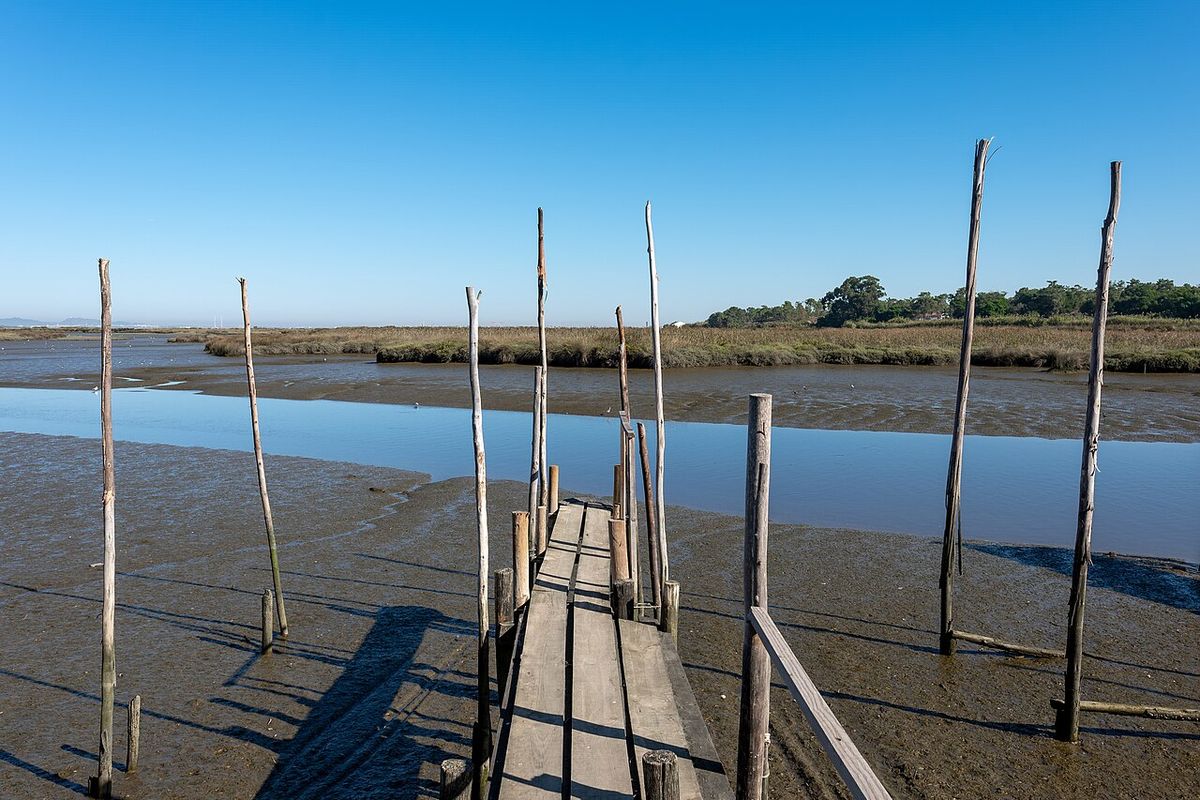
Photo: Jules Verne Times Two, via Wikimedia Commons, CC BY-SA 4.0
After the granite of the Serra da Estrela, the descent to the coast feels like a change of country. The land flattens, the air softens and the road runs through umbrella pine and cork oak towards the Atlantic. Comporta sits about an hour south of Lisbon, on the quiet stretch of coast between the Sado estuary and the open sea, and for a long time very few people outside Portugal had heard of it.
A working landscape
Comporta was a farming village before it was anything else. It grew up at the heart of the Herdade da Comporta, one of the great agricultural estates of Portugal, which from the 1920s onwards was given over largely to rice. The paddies are still there, flat and green in early summer, and the old rice-husking factory of 1952 now houses the Museu do Arroz, the rice museum, a short walk from the village.
The village itself is a handful of single-storey, whitewashed houses trimmed in blue or ochre, a small chapel and a square. White storks nest on the rooftops and chimneys. Comporta has acquired an international following and a reputation to go with it, but the place has kept its scale, and that restraint is much of the appeal.
The estuary
A few minutes inland, on the banks of the Sado, is the fishing village of Carrasqueira and its remarkable harbour. Because the muddy estuary banks leave boats stranded at low tide, the fishermen built a jetty on wooden stakes that zigzags out across the marsh, with small huts for nets and tackle along the way. It is still a working harbour. Go at the end of the day, when the water is still and the light turns the mudflats silver.
Those coming from Lisbon by the coast can cross the estuary by ferry from Setúbal to Tróia, a short and rather civilised way to arrive, with the Arrábida hills behind you.
Sublime Comporta
The place to stay is Sublime Comporta, set among the pines and cork trees just outside the village. It opened in 2014 as a small country retreat and has grown outwards into the trees rather than upwards. The architecture is by José Alberto Charrua; the interiors are by Miguel Câncio Martins, the Portuguese designer perhaps best known for the Buddha-Bar in Paris.
The estate now runs to 68 hectares across two wings, Terracotta, the original Sublime, and the newer Sand. Rooms, suites and villas are scattered across low buildings that take their cue from the region's old timber huts and rice barns, set far enough apart that you rarely see a neighbour. Sem Porta, the main restaurant, cooks Portuguese food with vegetables and herbs from the estate's own organic garden, and Food Circle seats a small table around an open fire while the chef cooks in front of you. The hotel also keeps a beach club on Praia do Carvalhal, a few minutes away through the pines.
After several days of mountain roads, it is exactly the right sort of pause: a long lunch, a swim, and nowhere in particular to be.
Onward
From Comporta the route turns south, down the Alentejo coast and into the Algarve, for three nights at Vila Vita Parc and the Portuguese Grand Prix at Portimão.
The Renisetté Portugal Grand Prix Supercar Tour stays at Sublime Comporta on its way south to the Algarve. The tour, 14 to 21 June 2027, is on renisette.com.